
Compare Agitator Types for High-Viscosity Liquid Mixing
- Compare Agitator Types for High-Viscosity Liquid Mixing
- Product overview: Sealed Homogenizing mixing tank for high-viscosity work
- Why agitator selection matters for a mixing tank with agitator
- Key properties to evaluate when selecting an agitator for high-viscosity mixing
- Common agitator types for high-viscosity liquids (what they do and when to use them)
- Anchor (or frame) agitators
- Helical ribbon agitators
- Double-anchor and toothed/banbury-style agitators
- Planetary (orbital) mixers
- Paddle and propeller designs (low to medium viscosity)
- High-shear rotor-stator and homogenizers
- Comparison table: agitator types vs. performance for high-viscosity mixing
- Energy, scale-up and power considerations for a mixing tank with agitator
- Sanitation, sealing and vacuum degassing: why they matter
- Integrating homogenization: rotor-stator vs. high-pressure homogenizers
- Practical recommendations: choosing the right configuration
- Case study snapshot: producing a high-viscosity cream
- Brand advantages: why choose our Sealed Homogenizing mixing tank
- FAQ — Common questions about mixing tanks with agitators for high-viscosity liquids
- Q: What agitator type is best for very high viscosities (>50,000 mPa·s)?
- Q: Can I use a rotor-stator homogenizer with thick creams?
- Q: How important is vacuum degassing?
- Q: How do I scale a formulation from lab to production?
- Q: What cleaning and sanitation features should I require?
- Contact sales / view product
- Authoritative references and further reading
- Final note
Compare Agitator Types for High-Viscosity Liquid Mixing
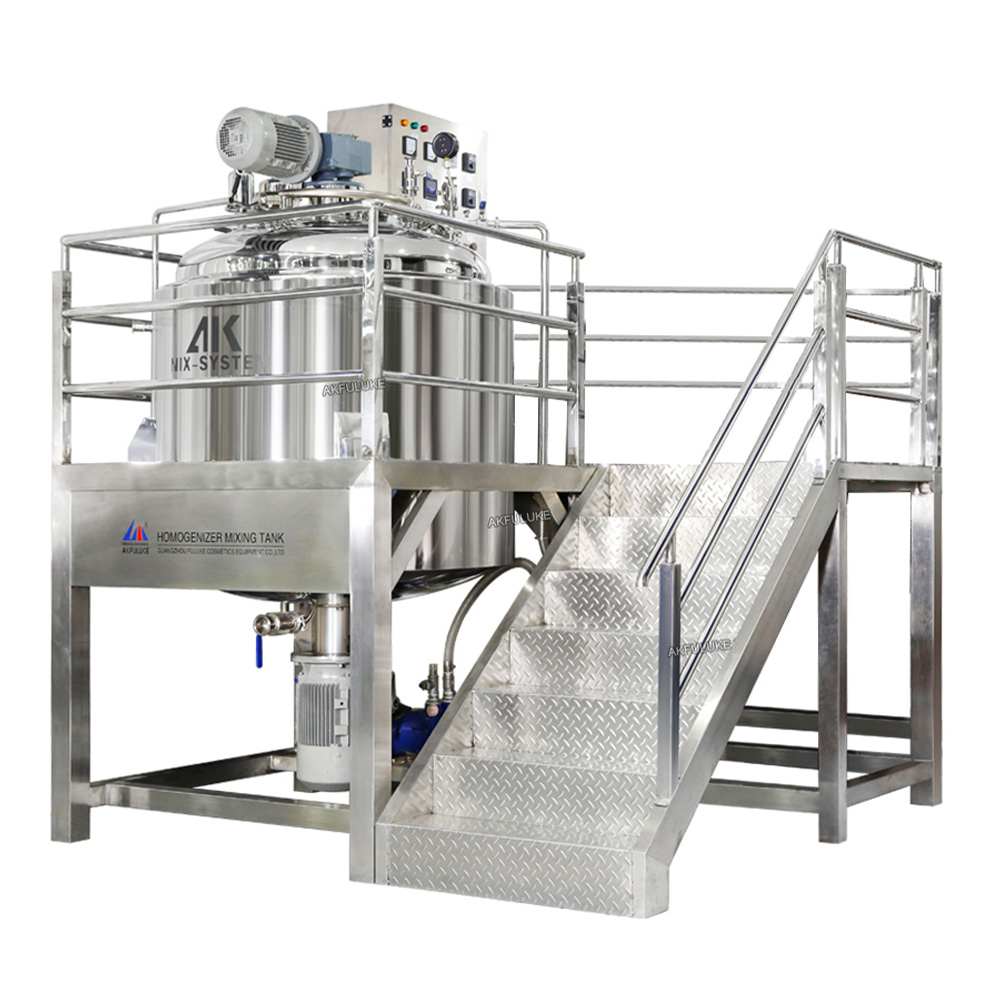
Choosing the right mixing tank with agitator is critical when working with high-viscosity materials in cosmetics, pharmaceuticals, food or chemicals. In this guide we compare common agitator types, explain operating considerations, and show how the Stainless Steel Mixer Liquid Mixing tank with Agitator Homogenizing Mixing tank Vacuum Sealed Mixer Machine solves typical production challenges for creams, gels and pastes. Selecting the right agitator is only part of the equation; seamless production depends on integrating mixer tanks with agitators into automated lines to support consistent throughput and scalability.
Product overview: Sealed Homogenizing mixing tank for high-viscosity work
The Sealed Homogenizing mixing tank is an industrial-grade material handling equipment that integrates four core functions: vacuum defoaming, high-speed homogenization, efficient stirring, and precise temperature control. It is widely used in the cosmetics, pharmaceutical, food, chemical and other industries.
It is specially designed to solve the mixing, emulsification, homogenization and degassing needs of high-viscosity, multi-phase (solid-liquid, liquid-liquid) materials. It can produce delicate, stable, bubble-free creams, lotions, gels, ointments, sauces and other products.
Why agitator selection matters for a mixing tank with agitator
High-viscosity liquids behave very differently from low-viscosity fluids. They resist flow, develop strong yield stress, and are prone to dead zones where material stagnates. The wrong agitator can cause long mixing times, overheating, insufficient dispersion of solids, and product defects like trapped air or poor emulsification. Matching the agitator type and geometry to your material and process is the fastest way to improve yield, reduce cycle time, and ensure repeatable quality.
Key properties to evaluate when selecting an agitator for high-viscosity mixing
Before choosing between anchor, helical ribbon, planetary or high-shear designs for a mixing tank with agitator, evaluate these process variables:
- Viscosity range (mPa·s to Pa·s or Pas): some designs work up to certain viscosities.
- Solids loading and particle size: solids suspension needs different flow.
- Heat transfer requirements: scraping designs improve wall heat transfer.
- Shear sensitivity: delicate emulsions need controlled shear.
- Degassing needs: vacuum and homogenization are often required.
- Cleaning and CIP capability: sanitary designs matter in cosmetics and pharma.
Common agitator types for high-viscosity liquids (what they do and when to use them)
Below are the most used agitator types for viscous formulations and the practical use cases for each in a mixing tank with agitator configuration.
Anchor (or frame) agitators
Anchor agitators use a broad, often rectangular loop that follows the vessel wall. They provide gentle, large-scale bulk motion and are excellent at scraping the tank walls, so they maintain heat transfer and minimize dead zones. Anchors work well for high-viscosity creams, pastes and products where gentle folding and wall-scraping are required.
Helical ribbon agitators
Helical ribbons create an axial flow that moves material from the tank ends to the center. They are very effective at handling extremely viscous liquids (thousands to tens of thousands of mPa·s) and are commonly used for polymers, adhesives and concentrated gels. Their continuous ribbon contacts a large surface area, providing strong bulk flow while limiting shear on the product.
Double-anchor and toothed/banbury-style agitators
Double-anchor and toothed agitators combine strong scraping with tethered mixing elements to handle materials that are sticky or have high yield stress. They are commonly used for heavy-duty mixing where solids must be incorporated into viscous matrices—such as body butters, ointments, and heavy pastes.
Planetary (orbital) mixers
Planetary mixers rotate blades on an orbital path, providing very uniform mixing and excellent incorporation of powders into viscous liquids. They are often used in R&D and small-batch production where homogeneity and repeatability are crucial. For larger-scale continuous operations, planetary drives can be scaled but with higher cost.
Paddle and propeller designs (low to medium viscosity)
Flat paddles and large-diameter propellers generate bulk flow and are suitable for low-to-medium viscosity ranges. For very viscous materials, their effectiveness drops and they can stall unless properly sized (low rpm, high torque) or combined with scrapers.
High-shear rotor-stator and homogenizers
High-shear rotor-stator devices and homogenizers introduce intense shear to break droplets, disperse particles, and deagglomerate solids. For cosmetic emulsions and lotions, a mixing tank with agitator that includes a homogenizing head provides fine droplet size and long-term stability. These systems typically operate at higher energy density and are best used when controlled shear is needed to achieve target droplet distribution.
Comparison table: agitator types vs. performance for high-viscosity mixing
The table below summarizes typical performance and best-use cases for a mixing tank with agitator in high-viscosity applications.
| Agitator Type | Effective Viscosity Range | Shear Level | Wall Heat Transfer | Best for | Pros | Cons |
|---|---|---|---|---|---|---|
| Anchor | Up to ~1,000–50,000 mPa·s | Low | High (scrapes wall) | Creams, pastes, thick solutions | Gentle, prevents dead zones, good heat transfer | Slower mixing, large torque required |
| Helical ribbon | 500–100,000+ mPa·s | Low–Medium | Good | Polymers, gels, very viscous masses | Excellent bulk flow for high viscosity | Complex shaft sealing, larger power draw |
| Double-anchor / toothed | 1,000–100,000+ mPa·s | Low–Medium | High | Sticky materials, solids incorporation | Handles adhesive materials, strong scraping | Higher wear, complex seals |
| Planetary | 100–100,000 mPa·s (lab to small-scale) | Low–High (depending on head) | Moderate | High homogeneity, R&D batches | Very uniform mixing, good for powders | Costly to scale, slower for large volumes |
| Rotor-stator / Homogenizer | 10–50,000 mPa·s (depends on design) | High | Low–Moderate | Emulsions, dispersions, degassing | Produces fine droplets, excellent dispersion | High energy, can over-shear delicate materials |
Energy, scale-up and power considerations for a mixing tank with agitator
Power draw increases dramatically with viscosity and tank volume. When scaling from lab to production, geometric similarity is not always sufficient—mixing regime (laminar, transitional, turbulent), required mixing time, and heat transfer change with scale. Typical guidance:
- Use low speeds and large-diameter, high-torque agitators (anchor/heli-ribbon) for laminar, viscous mixing.
- Include wall-scraping elements to maintain heat transfer coefficients in jacketed tanks.
- Consider in-tank homogenization (rotor-stator) for final droplet reduction while bulk mixing is done by ribbon/anchor blades.
Sanitation, sealing and vacuum degassing: why they matter
Cosmetics and pharmaceuticals require sanitary design and minimal contamination risk. High-viscosity mixers usually need robust shaft seals and often vacuum capability to remove entrained air and volatile solvents. A Sealed Homogenizing mixing tank offers:
- Vacuum defoaming to minimize air entrainment and improve stability.
- Sealed construction to protect product and enable controlled atmosphere processing.
- Easy-to-clean stainless steel surfaces and hygienic seals for CIP/sterilization.
Integrating homogenization: rotor-stator vs. high-pressure homogenizers
Two common approaches to producing stable emulsions and dispersions are rotor-stator (in-tank high-shear) and high-pressure homogenizers (external loop). Trade-offs:
- Rotor-stator (in the mixing tank with agitator): simple integration, immediate degassing under vacuum, excellent for medium-to-high viscosity products, lower equipment footprint.
- High-pressure homogenizers: produce very fine droplets for low-viscosity systems or when intense shear is required; often used in a recirculation loop after bulk mixing.
Practical recommendations: choosing the right configuration
Use this decision guide to pick a mixing tank with agitator configuration:
- Identify base viscosity and solids loading.
- If viscosity is >10,000 mPa·s, prefer helical ribbons or double-anchor designs with strong wall scraping.
- For mid-range viscosities (1,000–10,000 mPa·s) used in creams and gels, a combination of anchor/propeller for bulk flow plus an in-tank rotor-stator homogenizer often gives best results.
- If final product requires very fine droplets (<1 µm), plan for high-shear homogenization or high-pressure homogenizer in a loop.
- Always specify vacuum defoaming for air-sensitive or aesthetic products.
- Confirm sanitary finishes and materials (316L stainless, polished surfaces) for cosmetics and pharma.
Case study snapshot: producing a high-viscosity cream
Scenario: a cosmetic manufacturer needs a stable cream with dispersed actives and low air content. Solution:
- Bulk mixing with an anchor agitator to maintain wall scraping and heat transfer.
- Intermediate addition of solids with controlled shear to avoid agglomeration.
- Final in-tank homogenization using a rotor-stator head under vacuum to break droplets and remove air.
Brand advantages: why choose our Sealed Homogenizing mixing tank
When evaluating suppliers of a mixing tank with agitator, consider design maturity, service, materials, and integration features. Our Stainless Steel Mixer Liquid Mixing tank with Agitator Homogenizing Mixing tank Vacuum Sealed Mixer Machine offers:
- Integrated vacuum defoaming, high-speed homogenizing head, and efficient low-speed agitator for bulk flow—reducing the need for multiple pieces of equipment.
- 316L stainless steel construction, sanitary polishing, and CIP-compatible design for cosmetics and pharmaceuticals.
- Modular drive options (high-torque low-speed anchors, planetary heads) and scalable sizes from lab to production.
- Control systems for temperature, vacuum, and homogenizer speed that deliver repeatable, validated processes.
- After-sales support, spare parts availability, and documentation suitable for regulatory audits.
FAQ — Common questions about mixing tanks with agitators for high-viscosity liquids
Q: What agitator type is best for very high viscosities (>50,000 mPa·s)?
A: Helical ribbon or double-anchor (with scraping elements) are typically best. They create strong bulk flow and maintain wall contact for heat transfer. Planetary mixers may be used for small-batch or laboratory scale.
Q: Can I use a rotor-stator homogenizer with thick creams?
A: Yes, but ensure the homogenizer is rated for the product viscosity. In-tank rotor-stator devices in a vacuum-sealed mixing tank work well when blended with low-speed bulk agitation to keep material flowing to the homogenizing head.
Q: How important is vacuum degassing?
A: Very important for cosmetics and foods where trapped air affects appearance, stability, and shelf life. Vacuum defoaming during or after homogenization significantly reduces entrained air.
Q: How do I scale a formulation from lab to production?
A: Scale by similarity of mixing regime (energy per unit mass), maintain critical shear and residence time, and validate through pilot runs. Using the same mixing tank with agitator design (geometrically similar) reduces scale-up risk.
Q: What cleaning and sanitation features should I require?
A: Specify 316L stainless steel, sanitary ports, smooth welds, CIP spray balls or cleanable agitator shafts, and hygienic seals. Documentation for materials and surface finish (Ra) is important for audits.
Contact sales / view product
If you need help selecting the right mixing tank with agitator for your high-viscosity process, contact our technical sales team to discuss formulations, pilot testing, and full-scale systems. View product details, request a quote, or schedule a demonstration of the Stainless Steel Mixer Liquid Mixing tank with Agitator Homogenizing Mixing tank Vacuum Sealed Mixer Machine by contacting us today.
Authoritative references and further reading
For deeper technical background and validation of mixing concepts, consult the following sources:
- Mixing (process engineering) — Wikipedia: https://en.wikipedia.org/wiki/Mixing_(process_engineering)
- Agitator — Wikipedia: https://en.wikipedia.org/wiki/Agitator
- Mixers and Agitators — The Engineering Toolbox: https://www.engineeringtoolbox.com/mixers-agitators-d_894.
- Rotating equipment and mixing principles — ScienceDirect topics: https://www.sciencedirect.com/topics/engineering/mixing
Final note
Choosing the correct agitator for high-viscosity mixing is a mix of fluid mechanics, thermal management and practical plant considerations. A modern Stainless Steel Mixer Liquid Mixing tank with Agitator Homogenizing Mixing tank Vacuum Sealed Mixer Machine combines multiple functions into one validated unit—delivering consistent, bubble-free, high-quality products while simplifying production workflows. Contact us to match a specification to your product and production rate.
Filling Accuracy Testing Methods for Cosmetic Products
How to Choose a High-Precision Liquid Filling Machine
How to Customize Fill Volumes for Different Product SKUs
Material Compatibility: Plastics, Glass and Metal Bottles
Automatic Capping Machine
What causes leakage or loose caps after capping?
Most likely, the capping torque parameters do not match the product characteristics. You can recalibrate the torque through the touch screen. If the problem persists, check whether the bottle clamp is too loose or whether there is any dimensional deviation in the cap.
Inkjet Printing Machine
Who are we?
Our headquarters is located in Guangzhou, Guangdong, China, and our factory is located in Yangzhou, Jiangsu. Our products are sold all over the world. We have approximately 50 employees in our company and factory.
RO Water Treatment
Will poor raw water quality (such as high turbidity or hardness) affect the performance of RO equipment?
It can have a significant impact.
Highly turbid raw water (containing large amounts of sediment and colloids) can accelerate clogging of pre-filters (PP cotton) and activated carbon elements, shortening replacement cycles and increasing maintenance costs.Highly hard raw water (containing large amounts of calcium and magnesium ions) can easily form scale (calcium carbonate and magnesium carbonate) on the RO membrane surface, reducing filtration efficiency and even causing irreversible damage, shortening the life of the membrane.For this type of water quality, it is recommended to add a pretreatment device (such as a prefilter or softener) before the RO system to reduce the raw water's turbidity or hardness before entering the RO system.
Storage Tank
Do special operating conditions (such as high temperature or high pressure) require special customization?
Yes. High-temperature applications require the use of heat-resistant materials and additional insulation. High-pressure applications require enhanced tank wall thickness and sealing structures. Both require individual designs according to corresponding industry standards.
Perfume Filling Machine
What can you buy from us?
RO Water Treatment、Vacuum Emulsifying Machine、Homogenizer Mixing Tank、Filling and Capping、labeling Machine、Packing Machine、Storage Tank,etc.
You May Also Like
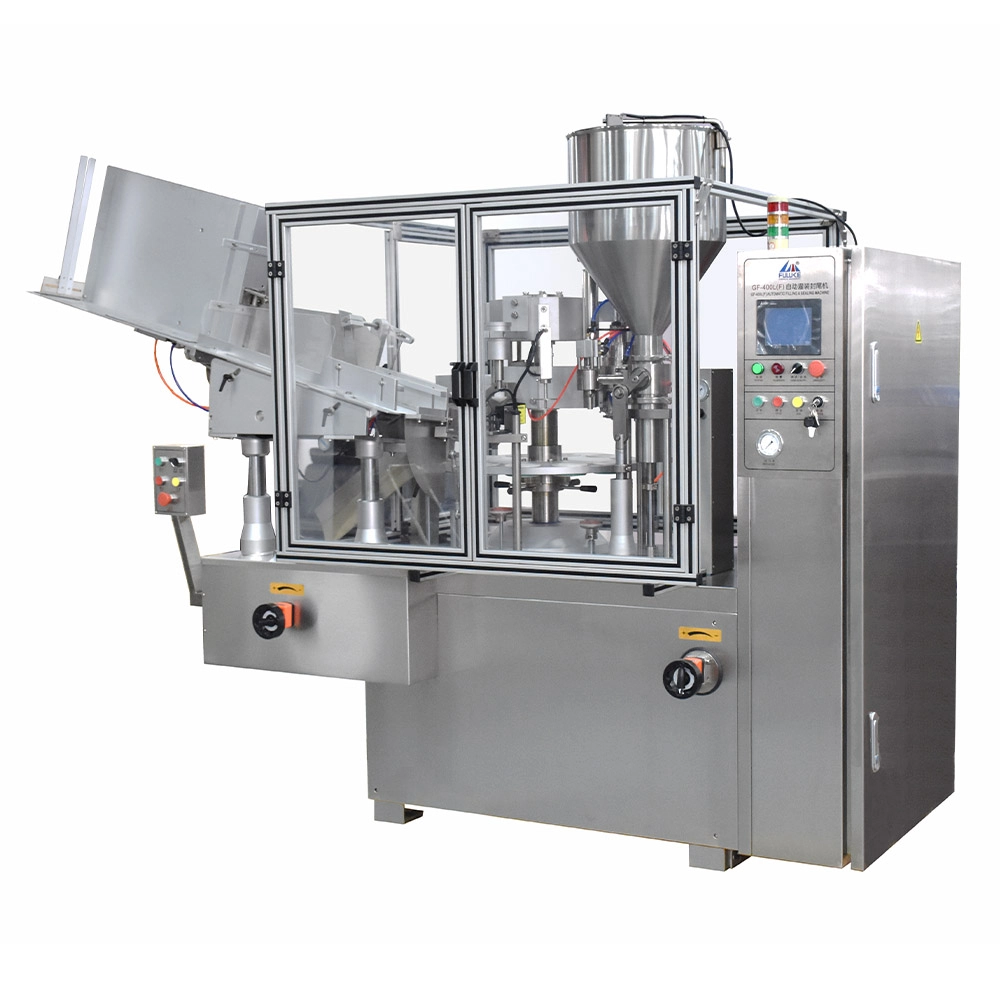
Automatic Tube Filling and Sealing Machine Toothpaste Sunscreen and Facial Cleanser Filling and Sealing Machine for Plastic and Aluminum-plastic Tube
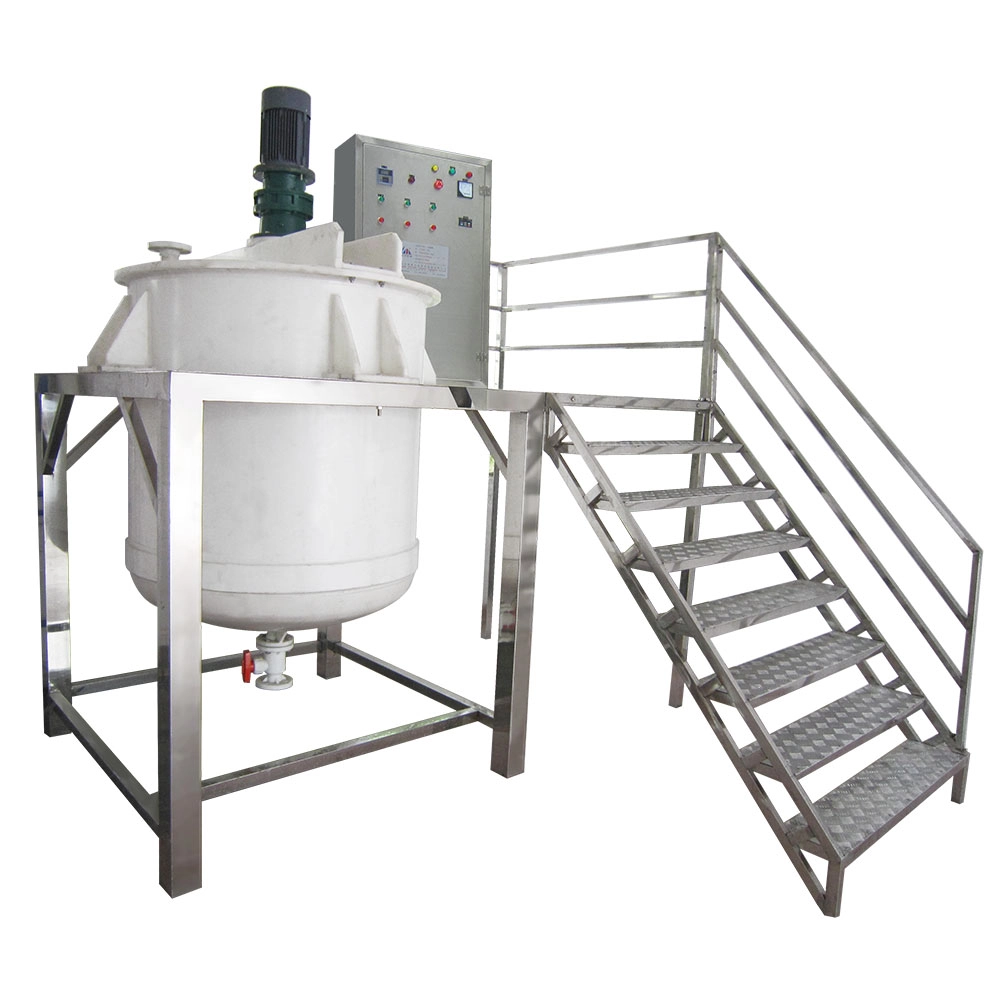
Polypropylene PP Mixing Tank Anti-Corrosion Mixer Reaction Kettle with Agitator Chemical Mixing Vessel
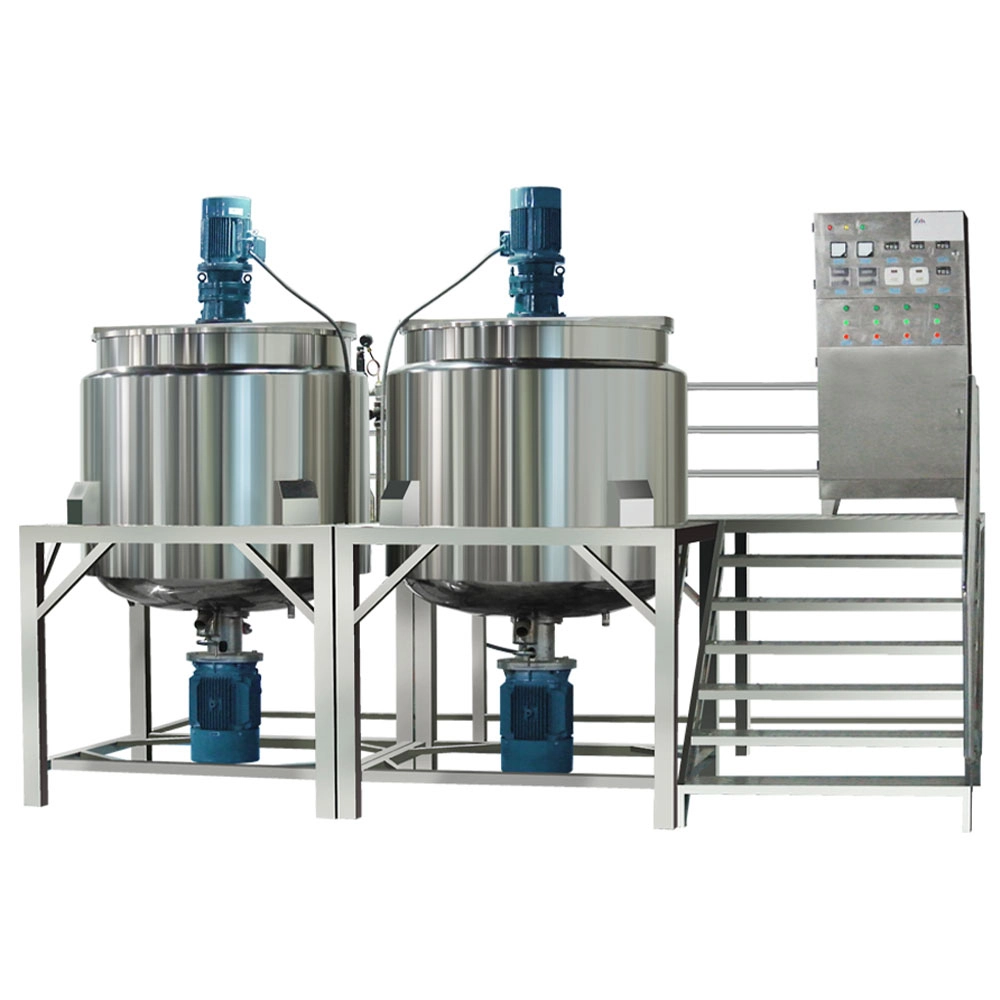
Flip Cover Multi-function Liquid Wash Mixing Tank Blender Liquid Detergent Mixer Homogenization Stirring Tank
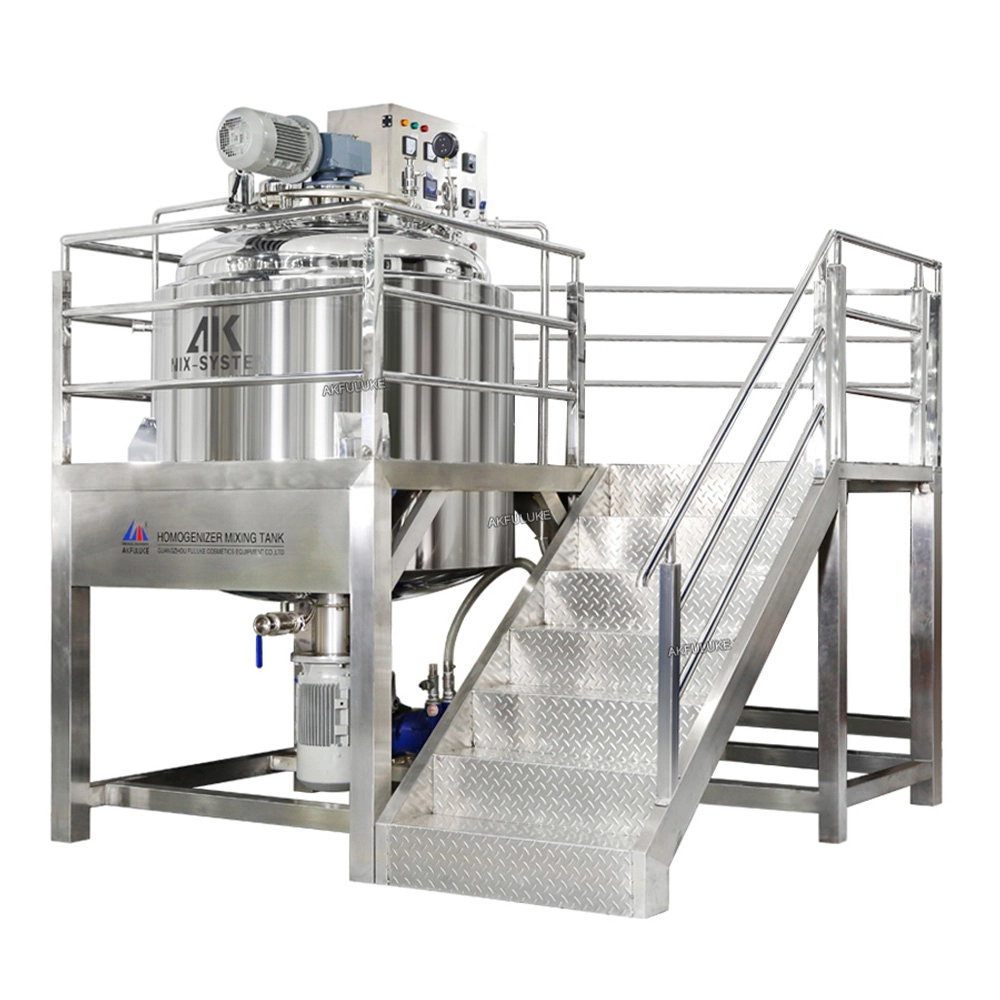
Stainless Steel Mixer Liquid Mixing tank with Agitator Homogenizing Mixing tank Vacuum Sealed Mixer Machine
Get in touch with FULUKE
If you have any comments or good suggestions, please leave us a message, later our professional staff will contact you as soon as possible.

A leading manufacturer specializing in advanced machinery and complete production lines for the cosmetics, food, pharmaceutical, and chemical industries worldwide.
Contact FULUKE
Facebook
Instagram
YouTube